
Are We Born with a Sweet Tooth? A Story of Taste, Memory and Genes
- Radha Sekharamantry

- Oct 15, 2025
- 5 min read
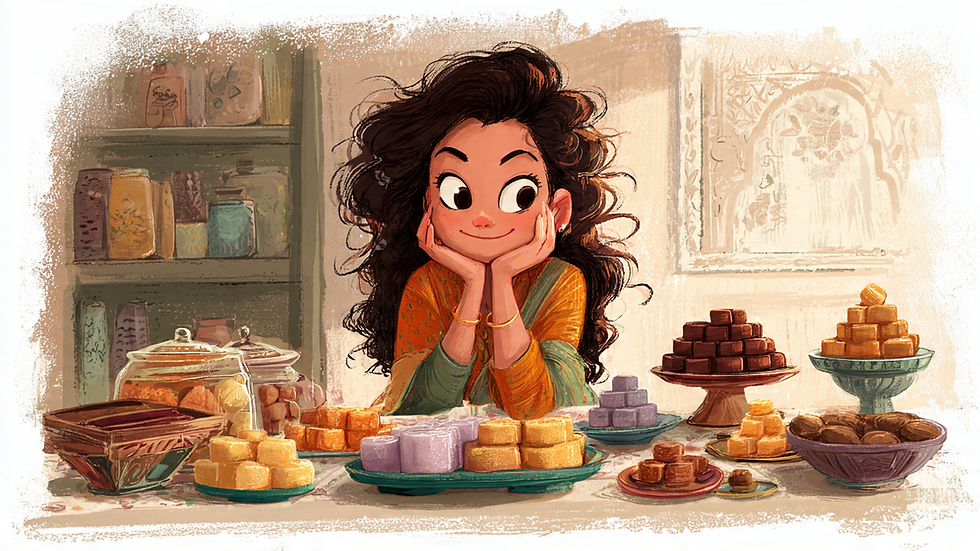
Think about how quickly your face lights up when someone offers you something sweet. It could be a piece of chocolate someone brought from a trip, a spoonful of kheer served at the end of a meal, or even that small sugar cube you secretly chewed as a child when no one was watching. Sweetness feels familiar and comforting—almost like a tiny celebration inside the mouth.
We often believe that our sweet preference comes from habit or upbringing. “My family loves sweets, so I do too,” we say. But what if the story begins much earlier—not in childhood, not in the kitchen, but deep within our genes, long before we are even born? What if our desire for sweetness isn’t just emotional or cultural… but biological?
Sweetness Begins at Birth
Babies show a natural preference for sweetness. A 2001 study published in Pediatrics observed newborns just minutes old. When scientists put a drop of sugar water on their tongues, the babies relaxed and their fists loosened. Their breathing also got steadier. These babies had no experience with sweets before. Their bodies just knew sweet tastes are calming and safe.
Fact 1: From an evolutionary view, sweetness signals energy and safety. Bitter flavors often indicate toxins. That is why our biology responds warmly to sugar long before society teaches us to enjoy it.
The Tongue: A Tiny Sensory Lab
We usually see the tongue as just a muscle. But biologically, it acts like a tiny research lab. It carries thousands of taste buds, and each taste bud has cells that detect flavors like sweet, sour, salty, bitter, and umami.
For sweetness, two receptors take the lead—TAS1R2 and TAS1R3.
Think of these receptors as tiny locks.
Sugar molecules act like keys.
When sugar fits into these locks, they send a signal to the brain: “This food contains energy. This tastes safe. Continue eating.”
But here’s where genes make a difference:
Some people inherit gene variants that make these receptors extremely efficient. They detect sweetness quickly and feel satisfied with just one or two bites of dessert.
Others inherit versions of TAS1R2 or TAS1R3 that respond slowly, meaning they need more sugar to feel the same level of satisfaction.
Fact 2: Your experience with sweets is not just about taste. It is about how your genes tune the sensitivity of your taste buds.
Sweetness and the Brain’s Reward Circuit
When your tongue detects sugar, it sends a signal to your brain. This signal goes to the dopamine pathway, also called “the reward pathway,” which is important for motivation, pleasure, and emotional responses to food.
Genes like DRD2 and SLC6A3 affect how well your brain releases dopamine.
If your brain releases dopamine quickly, a bite of something sweet feels rewarding.
If your dopamine response is weaker, you may feel the need to eat more to achieve the same satisfaction.
This explains why, after a long day or during emotional stress, some people crave sweets more. Their brain uses sugar as a quick emotional reset.
Fact 3: Brain imaging studies show that just thinking about sweet foods activates reward areas in people with certain dopamine-related gene variants.
Culture Builds on Biology; They Work Together
Genes give us the instinct to enjoy sweetness, while culture shapes how we show it.
Our ancestors looked for ripe fruits and honey, as these foods provided glucose, a quick energy source for survival. That instinct still exists in our biology today.
Modern culture only reinforces it:
In India, people enjoy sweets like laddu, kheer, gulab jamun, and jaggery during celebrations.
In Western cultures, birthdays feature cakes and frosted desserts.
Families bond, share laughter, and create memories, often with sweet food at the center.
Fact 4: Genetics determines how strongly we respond to sweets. Our society and culture reinforce these responses by connecting sugar with love, reward, and belonging.
How Genes, Hormones, and Cravings Interact
Genes influence more than just taste; they also affect our desire for sugar.
The FGF21 gene produces a hormone in the liver that regulates sugar intake. Higher levels of FGF21 can reduce sugar cravings.
Variants of the FTO gene are linked to higher sugar intake and a stronger desire for sweet, high-energy foods.
Variants of the PTPRN2 gene are connected to both a preference for sugar and emotional cravings related to stress.
Twin studies show that 40–60% of sweet preference is influenced by genetics, proving that sweetness is not merely a habit but is programmed.
Fact 5: Your genes act like a dial for sweetness cravings. Some people are naturally wired to feel these cravings more than others. Environment, family habits, stress, and culture adjust this dial over time.
Sweetness in Everyday Life; A Genetic Echo
Sugar shows up in our daily lives in small yet significant ways:
A spoonful of sugar in morning tea provides comfort, as your brain receives a gentle dopamine reward, reinforcing the habit.
Children running home asking, “Is there something sweet?” are not just developing habits; their brains and genes are learning which foods indicate safety and pleasure.
At weddings or festivals, sharing sweets is more than a tradition; it reflects an ancient instinct to share energy-rich food that brings joy.
Each of these moments tells the same biological story: taste buds detect energy, genes influence response, the brain rewards the action, and culture locks it into memory.
Finding Balance Without Guilt
Realizing that your preference for sweets is partly inherited helps you see it differently.
Notice your biology, not your weakness: Instead of telling yourself, “Why can’t I control myself?” try saying, “My body is designed to enjoy sweetness. I can still choose how I respond.”Just like we naturally feel sleepy after a heavy lunch or crave chai during an evening slump, wanting something sweet is a normal body signal, not a personal flaw.
Enjoy sweets with something wholesome: If you love a piece of chocolate after dinner or a bit of jaggery after lunch like many Indian households do, pair it with nuts, fruit, or a balanced meal. For example, a small peda after a proper lunch feels satisfying, while eating sweets on an empty stomach makes cravings stronger and more frequent. Pairing helps your blood sugar rise gently, keeping the body calm instead of demanding more.
Taste, don’t just eat: Think of how slowly we enjoy a festival sweet or a homemade dessert from a loved one. One mindful bite feels more special than eating a whole box absentmindedly while scrolling on your phone. When you slow down, your brain catches up and signals satisfaction earlier, so a small portion feels enough.
Let sweetness be one option, not the only comfort: After a stressful day, many of us say, “I need something sweet right now.” But often, what we actually need is a small break, a quick walk, a funny video, a phone call, or even a quiet moment to breathe. These simple actions can release dopamine too. Think of sugar as one way to feel good—not the only way.
Speak gently about sweets with children (and yourself): Instead of strict lines like “Sugar is bad,” try saying, “Our body enjoys sweet things. Let’s have a little now and save the rest for later so we can enjoy it again.” This simple shift keeps pleasure, control, and awareness together, helping both children and adults enjoy sweets without guilt or obsession.
So the next time you take a bite of dessert or stir sugar into your tea, remember that it isn’t just a habit. It is a quiet conversation between your genes, your tongue, your brain, and your memories.
References
1. https://pubmed.ncbi.nlm.nih.gov/11256953/
2. https://pubmed.ncbi.nlm.nih.gov/851021/
3. https://www.ncbi.nlm.nih.gov/pmc/articles/PMC5733356/
4. https://www.sciencedirect.com/science/article/abs/pii/S0195666321001884
5. https://www.frontiersin.org/articles/10.3389/fgene.2019.01272/full
6. https://www.frontiersin.org/articles/10.3389/fgene.2019.01272/full
7. https://www.ncbi.nlm.nih.gov/pmc/articles/PMC6537940/
8. https://www.researchgate.net/publication/288057719_FGF21_Mediates_Endocrine_Control_of_Simple_Sugar_Intake_and_Sweet_Taste_Preference_by_the_Liver
9. https://www.ncbi.nlm.nih.gov/pmc/articles/PMC12270579/
10. https://ajcn.nutrition.org/article/S0002-9165(23)27451-1/fulltext
11. https://www.mdpi.com/2227-9059/10/1/79


Yes we are born with a sweet tooth 😀
Wow this article is amazing 🤩, so much of hidden facts about sweet tooth, nice...
Very good genetic and behavioral analysis ,with good tips for sweet lovers and parents. A sweet article on sweets. As sweet loving senior citizen I thank you for the analysis and tips to enjoy sweets better